A comparative analysis of major global privacy laws: GDPR, CCPA, and LGPD. Understand their similarities and differences.
A comparative analysis of major global privacy laws: GDPR, CCPA, and LGPD. Understand their similarities and differences.
Comparing Global Privacy Laws GDPR vs CCPA vs LGPD
Hey there! Ever feel like navigating the world of digital privacy laws is like trying to solve a Rubik’s Cube blindfolded? You’re not alone. With data breaches making headlines almost daily and our personal information being collected at an unprecedented rate, governments worldwide are stepping up to protect their citizens’ digital rights. This has led to a patchwork of regulations, with the General Data Protection Regulation (GDPR) from Europe, the California Consumer Privacy Act (CCPA) from the United States, and Brazil’s Lei Geral de Proteção de Dados (LGPD) standing out as some of the most influential. But what do these acronyms actually mean for you, your data, and businesses operating globally? Let’s dive in and break down the similarities, differences, and practical implications of these three privacy titans.
Understanding the Core Principles of Data Privacy Regulations
Before we get into the nitty-gritty of each law, it’s helpful to understand the common threads that weave through most modern data privacy regulations. At their heart, these laws aim to give individuals more control over their personal data and hold organizations accountable for how they collect, process, and store that information. Think of it as a digital bill of rights for your personal information. Key principles often include:
- Transparency: Organizations must be clear about what data they’re collecting, why they’re collecting it, and how they’re using it. No more hidden clauses in mile-long terms and conditions!
- Purpose Limitation: Data should only be collected for specified, explicit, and legitimate purposes. You can’t just collect everything and figure out what to do with it later.
- Data Minimization: Only collect the data that’s absolutely necessary for the stated purpose. Less data means less risk.
- Accuracy: Personal data should be accurate and kept up to date. If it’s wrong, you should have the right to correct it.
- Storage Limitation: Data shouldn’t be kept for longer than necessary. Once the purpose is fulfilled, it should be deleted or anonymized.
- Integrity and Confidentiality: Data needs to be protected from unauthorized or unlawful processing and from accidental loss, destruction, or damage. This is where cybersecurity measures come into play.
- Accountability: Organizations are responsible for demonstrating compliance with these principles. They can’t just say they’re compliant; they have to prove it.
These principles form the bedrock of what we’ll be discussing. Now, let’s meet our main contenders.
GDPR The Gold Standard of European Data Protection
The General Data Protection Regulation (GDPR) came into effect in May 2018 and quickly became the benchmark for data privacy worldwide. It’s a comprehensive law designed to harmonize data privacy laws across Europe, protect EU citizens’ data, and reshape the way organizations approach data privacy. Even if you’re not in Europe, if you deal with data from EU residents, GDPR applies to you. This is what’s known as its ‘extraterritorial reach.’
Key Features and Rights Under GDPR for EU Citizens
GDPR grants individuals a robust set of rights, often referred to as ‘data subject rights.’ These include:
- Right to Access: You can ask organizations if they’re processing your personal data and, if so, get a copy of it.
- Right to Rectification: If your data is inaccurate or incomplete, you have the right to have it corrected.
- Right to Erasure (Right to Be Forgotten): In certain circumstances, you can request that your personal data be deleted. Think of it as hitting the ‘delete’ button on your digital past.
- Right to Restriction of Processing: You can request that the processing of your personal data be limited.
- Right to Data Portability: You have the right to receive your personal data in a structured, commonly used, and machine-readable format and to transmit that data to another controller.
- Right to Object: You can object to the processing of your personal data in certain situations, including for direct marketing.
- Rights in Relation to Automated Decision Making and Profiling: You have the right not to be subject to a decision based solely on automated processing, including profiling, which produces legal effects concerning you or similarly significantly affects you.
For businesses, GDPR introduced strict requirements like mandatory data protection officers (DPOs) for certain organizations, data protection impact assessments (DPIAs) for high-risk processing, and a 72-hour data breach notification window. The penalties for non-compliance are significant, up to €20 million or 4% of annual global turnover, whichever is higher. This has certainly gotten the attention of companies worldwide!
CCPA California’s Landmark Privacy Legislation in the US
Across the Atlantic, California introduced the California Consumer Privacy Act (CCPA) in January 2020, making it the first comprehensive privacy law in the United States. While it shares many similarities with GDPR, it also has its own unique flavor, reflecting the American legal and business landscape. It primarily focuses on giving California consumers more control over their personal information.
Consumer Rights and Business Obligations Under CCPA
CCPA grants California consumers several key rights:
- Right to Know: Consumers have the right to know what personal information is being collected about them, where it came from, what it’s used for, and whether it’s sold or disclosed.
- Right to Delete: Consumers can request that businesses delete personal information collected from them.
- Right to Opt-Out of Sale: This is a big one! Consumers have the right to opt-out of the sale of their personal information to third parties. Businesses must provide a clear and conspicuous ‘Do Not Sell My Personal Information’ link on their websites.
- Right to Non-Discrimination: Businesses cannot discriminate against consumers for exercising their CCPA rights (e.g., by charging different prices or providing different levels of service).
Unlike GDPR, CCPA’s scope is generally limited to businesses that meet certain thresholds, such as having annual gross revenues over $25 million, annually buying, receiving, or selling the personal information of 50,000 or more California consumers, households, or devices, or deriving 50% or more of their annual revenues from selling consumers’ personal information. The penalties for CCPA violations are less severe than GDPR but still significant, ranging from $2,500 per unintentional violation to $7,500 per intentional violation. It’s also worth noting that the California Privacy Rights Act (CPRA), which came into full effect in January 2023, expanded and strengthened CCPA, introducing new rights and establishing the California Privacy Protection Agency (CPPA) to enforce the law.
LGPD Brazil’s Comprehensive Data Protection Framework
Moving to South America, Brazil’s Lei Geral de Proteção de Dados (LGPD) came into effect in September 2020, drawing heavily from the GDPR. It aims to protect the fundamental rights of freedom, privacy, and the free development of the personality of the natural person, establishing clear rules for the collection, processing, and storage of personal data. Like GDPR, LGPD has extraterritorial reach, applying to any processing of personal data carried out in Brazil or related to individuals located in Brazil, regardless of where the data processing company is located.
Data Subject Rights and Compliance Requirements Under LGPD
LGPD grants Brazilian citizens a comprehensive set of data subject rights, very similar to those found in GDPR:
- Right to Access: Individuals can request confirmation of the existence of processing and access to their personal data.
- Right to Correction: The right to correct incomplete, inaccurate, or outdated data.
- Right to Anonymization, Blocking, or Deletion: The right to have unnecessary, excessive, or unlawfully processed data anonymized, blocked, or deleted.
- Right to Data Portability: The right to receive personal data in a structured, interoperable, and machine-readable format.
- Right to Deletion: The right to have personal data deleted, except in specific cases provided by law.
- Right to Information: The right to information about public and private entities with which the controller has shared data.
- Right to Revoke Consent: The right to revoke consent at any time.
- Right to Object: The right to object to processing that does not comply with the LGPD.
For businesses, LGPD mandates the appointment of a Data Protection Officer (DPO), requires data protection impact assessments (DPIAs) for high-risk processing, and sets out strict rules for obtaining consent. The penalties for non-compliance can reach up to 2% of a company’s revenue in Brazil for the previous fiscal year, capped at 50 million Brazilian Reais (approximately $10 million USD) per infraction. This shows Brazil’s serious commitment to data privacy.
GDPR vs CCPA vs LGPD A Comparative Analysis of Global Privacy Frameworks
Now that we’ve looked at each law individually, let’s put them side-by-side to highlight their key similarities and differences. This will help you understand the nuances and why a ‘one-size-fits-all’ approach to global privacy compliance just doesn’t cut it.
Scope and Applicability Who Do These Laws Protect and Affect
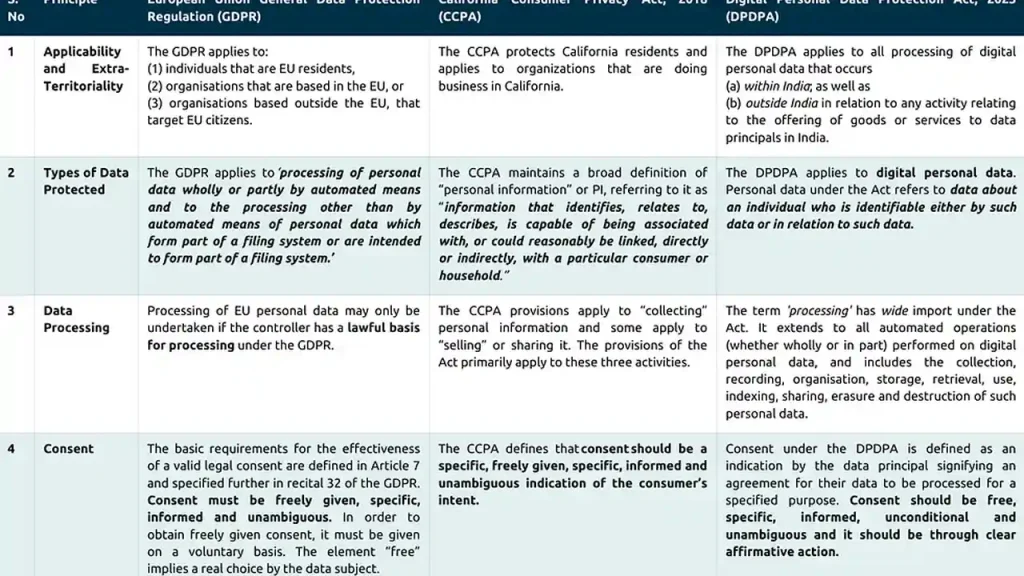
- GDPR: Protects the personal data of individuals residing in the European Union, regardless of their nationality. It applies to any organization, anywhere in the world, that processes the personal data of EU residents or offers goods/services to them. Very broad extraterritorial reach.
- CCPA: Protects the personal information of California residents. It applies to for-profit businesses that collect personal information from California consumers and meet specific revenue or data processing thresholds. Its reach is primarily within California, though businesses outside California that meet the criteria are also subject to it.
- LGPD: Protects the personal data of individuals located in Brazil. It applies to any processing operation carried out in Brazil, or if the processing activities are aimed at offering goods or services to individuals located in Brazil, or if the personal data was collected in Brazil. Similar broad extraterritorial reach to GDPR.
Key Takeaway: If you’re a global business, you’re likely dealing with all three. GDPR and LGPD have a broader geographical scope in terms of who they protect and affect, while CCPA is more geographically focused on California residents but still impacts businesses globally if they interact with California consumers.
Definitions of Personal Data What Information is Protected
- GDPR: Defines ‘personal data’ very broadly as any information relating to an identified or identifiable natural person (‘data subject’). This includes names, identification numbers, location data, online identifiers (like IP addresses), and factors specific to the physical, physiological, genetic, mental, economic, cultural, or social identity of that natural person.
- CCPA: Defines ‘personal information’ as information that identifies, relates to, describes, is reasonably capable of being associated with, or could reasonably be linked, directly or indirectly, with a particular consumer or household. This includes identifiers (like real name, alias, postal address, unique personal identifier, online identifier, IP address, email address, account name, SSN, driver’s license number, passport number), characteristics of protected classifications, commercial information, biometric information, internet or other electronic network activity information, geolocation data, audio/electronic/visual/thermal/olfactory/similar information, professional or employment-related information, education information, and inferences drawn from any of the above.
- LGPD: Defines ‘personal data’ as information related to an identified or identifiable natural person. It also introduces ‘sensitive personal data,’ which includes data about racial or ethnic origin, religious belief, political opinion, trade union affiliation or religious, philosophical, or political organization, data related to health or sex life, genetic or biometric data, when linked to a natural person.
Key Takeaway: All three have broad definitions of what constitutes protected information, but LGPD explicitly calls out ‘sensitive personal data’ with stricter processing rules, similar to GDPR’s ‘special categories of personal data.’ CCPA’s definition is also very comprehensive, covering a wide range of identifiers and inferred data.
Legal Bases for Processing Data Why Can Businesses Use Your Data
- GDPR: Requires a lawful basis for processing personal data. The most common bases are consent, contractual necessity, legal obligation, vital interests, public task, or legitimate interests. Consent must be freely given, specific, informed, and unambiguous.
- CCPA: Doesn’t explicitly require a ‘legal basis’ in the same way GDPR does. Instead, it focuses on giving consumers the right to know and the right to opt-out of the sale of their data. For certain activities, like selling data, explicit opt-out mechanisms are required.
- LGPD: Similar to GDPR, LGPD requires a legal basis for processing personal data. It lists ten legal bases, including consent, compliance with a legal or regulatory obligation, execution of public policies, studies by research bodies, execution of a contract, exercise of rights in judicial, administrative, or arbitration proceedings, protection of life or physical safety, health protection, legitimate interests, and credit protection. Consent under LGPD is also very strict, requiring clear and explicit agreement.
Key Takeaway: GDPR and LGPD are more prescriptive about the legal grounds for processing data, with consent being a primary, but not exclusive, basis. CCPA focuses more on consumer control over the ‘sale’ of data rather than requiring a specific legal basis for all processing activities.
Individual Rights How Much Control Do You Have
We’ve already touched on these, but let’s summarize the key differences:
- GDPR: Offers the most comprehensive set of individual rights, including access, rectification, erasure (right to be forgotten), restriction, data portability, objection, and rights related to automated decision-making.
- CCPA: Focuses on the rights to know, delete, and opt-out of the sale of personal information, along with the right to non-discrimination. The ‘right to opt-out of sale’ is a distinctive feature.
- LGPD: Very similar to GDPR, offering rights to access, correction, anonymization/blocking/deletion, data portability, deletion, information about sharing, and revocation of consent.
Key Takeaway: GDPR and LGPD provide a broader range of data subject rights, particularly the ‘right to be forgotten’ and data portability. CCPA’s ‘right to opt-out of sale’ is its most unique and impactful right.
Enforcement and Penalties What Happens if You Don’t Comply
- GDPR: Enforced by Data Protection Authorities (DPAs) in each EU member state. Penalties are severe: up to €20 million or 4% of annual global turnover, whichever is higher.
- CCPA: Enforced by the California Attorney General and, with CPRA, by the California Privacy Protection Agency (CPPA). Penalties are $2,500 per unintentional violation and $7,500 per intentional violation. It also includes a private right of action for data breaches, allowing consumers to sue businesses directly.
- LGPD: Enforced by the Autoridade Nacional de Proteção de Dados (ANPD), Brazil’s national data protection authority. Penalties can be up to 2% of a company’s revenue in Brazil, capped at 50 million Brazilian Reais per infraction.
Key Takeaway: All three laws carry significant penalties, demonstrating the seriousness with which these governments view data privacy. GDPR’s penalties are arguably the highest in terms of potential financial impact, but CCPA’s private right of action adds another layer of risk for businesses.
Practical Implications for Businesses Navigating the Global Privacy Landscape
So, what does all this mean for businesses, especially those operating across borders? It means that a fragmented approach to privacy compliance is no longer sustainable. You can’t just comply with one law and call it a day. Here are some practical implications and strategies:
Developing a Unified Global Privacy Strategy for Data Handling
Many businesses are adopting a ‘GDPR-plus’ approach, meaning they aim for GDPR compliance as a baseline and then layer on the specific requirements of other laws like CCPA and LGPD. This often involves:
- Comprehensive Data Mapping: Understanding what personal data you collect, where it comes from, where it’s stored, who it’s shared with, and for what purpose. Tools like OneTrust or TrustArc can be incredibly helpful here. They offer platforms for data mapping, consent management, and fulfilling data subject access requests (DSARs). OneTrust, for example, provides a suite of privacy management tools, including universal consent and preference management, data mapping automation, and incident response. TrustArc offers similar solutions with a focus on privacy program management and compliance.
- Robust Consent Management Platforms (CMPs): Especially crucial for GDPR and LGPD. You need systems to obtain, record, and manage user consent effectively. Popular CMPs include Cookiebot and OneTrust’s Cookie Consent. Cookiebot is known for its automatic cookie scanning and declaration, making it easier to comply with various cookie regulations.
- Streamlined Data Subject Access Request (DSAR) Processes: Individuals have the right to access, correct, or delete their data. You need efficient processes and tools to handle these requests within the legally mandated timeframes. Again, platforms like OneTrust and TrustArc offer modules specifically for DSAR management.
- Regular Data Protection Impact Assessments (DPIAs): For high-risk processing activities, especially under GDPR and LGPD. This involves assessing and mitigating privacy risks before new projects or technologies are deployed.
- Appointing a Data Protection Officer (DPO): Mandatory for certain organizations under GDPR and LGPD. Even if not mandatory, having a dedicated privacy expert is a best practice.
- Vendor Management: Ensuring that any third-party vendors or service providers you share data with are also compliant with relevant privacy laws. This often involves robust data processing agreements (DPAs).
Choosing the Right Privacy Management Tools and Platforms
Implementing a global privacy strategy can be complex, but several tools can help. Here are a few examples, keeping in mind that pricing can vary significantly based on the size of your organization and the features you need:
- OneTrust
- Description: OneTrust is a leading privacy management software platform that helps organizations operationalize privacy, security, and data governance programs. It offers a comprehensive suite of tools for consent management, data mapping, DSAR fulfillment, incident response, vendor risk management, and more.
- Use Cases: Ideal for large enterprises and organizations with complex global privacy requirements. It’s particularly strong for managing GDPR, CCPA, LGPD, and other global regulations from a single platform.
- Pros: Very comprehensive feature set, scalable, strong reporting and analytics, widely recognized in the industry.
- Cons: Can be complex to implement and manage, potentially expensive for smaller businesses, steep learning curve.
- Estimated Pricing: Enterprise-level pricing, often custom quotes. Expect to pay thousands to tens of thousands of dollars annually, depending on modules and scale.
- TrustArc
- Description: TrustArc provides privacy management solutions, including privacy program management, consent and preference management, data inventory and mapping, and risk assessments. They also offer privacy consulting services.
- Use Cases: Suitable for medium to large businesses looking for a robust privacy management platform with a focus on compliance and risk assessment.
- Pros: Strong focus on compliance, good for risk management, offers consulting services to guide implementation.
- Cons: Interface can feel a bit dated compared to newer platforms, may require significant internal resources for full utilization.
- Estimated Pricing: Similar to OneTrust, enterprise-level pricing with custom quotes.
- Cookiebot by Usercentrics
- Description: Specifically designed for cookie and consent management, Cookiebot automatically scans your website to identify all cookies and trackers, then generates a compliant consent banner and cookie declaration. It helps with GDPR, CCPA, LGPD, and other cookie laws.
- Use Cases: Excellent for any website or online service that uses cookies and needs to comply with consent requirements. Particularly useful for e-commerce sites, publishers, and marketing agencies.
- Pros: Easy to set up, automatic scanning, good for multi-language support, affordable for smaller sites.
- Cons: Primarily focused on cookie consent, not a full privacy management platform.
- Estimated Pricing: Free for small websites (up to 50 pages). Paid plans start from around €12-€49 per month per domain, scaling up with the number of pages and features.
- Termly
- Description: Termly offers a suite of compliance solutions, including a consent management platform, privacy policy generator, and cookie scanner. It’s designed to help businesses comply with GDPR, CCPA, LGPD, and other regulations without needing deep legal expertise.
- Use Cases: Great for small to medium-sized businesses, startups, and individuals who need an accessible and affordable way to manage their privacy compliance.
- Pros: User-friendly interface, good for generating legal policies, more affordable than enterprise solutions.
- Cons: May not have the depth of features required for very large or complex organizations compared to OneTrust.
- Estimated Pricing: Free plan available with limited features. Paid plans start from around $10-$45 per month, depending on the number of websites and features.
When choosing a tool, consider your organization’s size, complexity, budget, and the specific privacy laws you need to comply with. A smaller business might start with Termly or Cookiebot, while a large multinational would likely need a comprehensive platform like OneTrust or TrustArc.
The Evolving Landscape of Digital Privacy What’s Next
The world of digital privacy laws is far from static. We’re seeing a trend towards more comprehensive privacy legislation globally. Countries like Canada (PIPEDA), Australia (Privacy Act), India (Digital Personal Data Protection Act), and many others are either updating existing laws or introducing new ones. The US itself is seeing a proliferation of state-level privacy laws beyond California, with states like Virginia (VCDPA), Colorado (CPA), Utah (UCPA), and Connecticut (CTDPA) enacting their own versions. This creates an even more complex compliance environment.
Emerging Trends and Future Challenges in Data Protection
Some key trends and challenges to watch out for include:
- Increased Focus on AI and Data Privacy: As AI becomes more prevalent, how it processes personal data, makes automated decisions, and potentially creates new forms of identifiable information will be a major area of regulatory focus.
- Cross-Border Data Transfers: The rules around transferring data across different jurisdictions continue to evolve, especially between the EU and the US. Ensuring legal mechanisms like Standard Contractual Clauses (SCCs) are properly implemented is crucial.
- Enforcement and Fines: We can expect to see more enforcement actions and potentially higher fines as data protection authorities mature and gain more experience.
- Harmonization vs. Fragmentation: While there’s a desire for global harmonization of privacy laws, the reality is often more fragmentation, requiring businesses to adapt to multiple, sometimes conflicting, requirements.
- Consumer Awareness: As consumers become more aware of their privacy rights, they are more likely to exercise them, leading to an increase in DSARs and complaints.
Staying informed about these developments is key to maintaining compliance and building trust with your customers. It’s not just about avoiding fines; it’s about demonstrating a commitment to respecting individual privacy.
Final Thoughts on Navigating Global Privacy Regulations
Navigating the complexities of GDPR, CCPA, LGPD, and the myriad of other privacy laws can feel daunting. However, by understanding their core principles, recognizing their similarities and differences, and leveraging the right tools and strategies, businesses can build robust privacy programs that protect data, foster trust, and ensure compliance. Remember, privacy isn’t just a legal obligation; it’s a fundamental right and a critical component of building a responsible and ethical digital presence. Keep learning, keep adapting, and keep prioritizing privacy in everything you do online.